[unable to retrieve full-text content]
Here come the lorikeets! How garden trends can change the local wildlife The GuardianHere come the lorikeets! How garden trends can change the local wildlife - The Guardian
Read More
[unable to retrieve full-text content]
Here come the lorikeets! How garden trends can change the local wildlife The Guardian
Farmers in WA and around Australia are no doubt concerned about skyrocketing fertiliser prices due to surging energy costs and export restrictions on suppliers.
As geopolitical instability affecting some of the world’s major potash-producing nations disrupts global supply chains, the case for developing a home-grown potash industry gains ground.
Russia’s invasion of Ukraine is having an impact on global food supply chains, threatening food security, particularly in countries already seeing the impact of climate change, increasing food prices and disruption to supply chains from COVID-19.
As Russia restricts access to parts of the Black Sea, it is cutting shipping supply routes used to move goods, including potash, out of the region.
The European Union and the US have also imposed sanctions on potash producer Belarus, partly due to a migration crisis on the Poland-Belarus border.

Belarus is the world’s third-largest potash supplier, accounting for about 20 per cent of global supply of Muriate of Potash, however exports have been significantly disrupted by the sanctions.
In addition, Ukraine has indefinitely banned the transit of potash from Russian ally Belarus by rail, cutting off supplies to countries including Slovakia, Hungary, Austria and Poland.
It’s estimated about 700,000 tonnes of potash was carried via this supply route in 2021.
Prime Minister Scott Morrison rightly pointed out last week that the best way to minimise the impact of global supply chain disruptions in Australia was to shift our focus to developing our own industries and manufacturing our own goods.
One of the areas Mr Morrison highlighted was agricultural chemicals, including fertilisers.
Sulphate of Potash is a green, premium potassium fertiliser used by farmers in Australia and around the world which benefits chloride-sensitive crops such as root vegetables, fruits and coffee beans.
Without it, the world would struggle to feed itself.
Australia currently does not produce any potash, but a number of players in Western Australia are trying to change that.
WA has some of the best primary resources of SOP in the world.
Add to that plenty of sunshine to enable environmentally friendly solar-salt production, a positive regulatory environment and low sovereign risk, and you have all the ingredients necessary for a successful, and sustainable, new industry.
But in order for the emerging industry to succeed, it needs support from government and investors.
And time.
Unfortunately, potential potash producers don’t have a tap we can just turn on to mitigate the supply chain issues the world is currently facing.
In the case of Australian Potash Limited and our Lake Wells project in the north-eastern Goldfields of WA, we have spent six years in the discovery and development phases, and it will be a while yet until production commences.
Unfortunately, we’ve seen some of the players in our emerging industry stumble. Every new industry has its teething problems, and potash is not immune to this.
What we need to do is learn from the mistakes others have made and ensure we do things differently.
APC made a strategic decision early on not to employ the technique of digging large trenches to produce SOP and have instead chosen to develop a 100 per cent borefield operation.
We are the only potential potash producer to do this.
We believe a borefield operation enables us to have the most control over the amount of brine in our ponds, which is essential to producing SOP.
We believe it’s what is going to make our operation viable so that Australian farmers can have confidence in our quality and supply.
By establishing a successful industry in WA, farmers in Australia will have access to a premium, organic, sustainable product which will enable them to grow better, healthier crops on their land and shield them from the disruptions to supply caused by factors far beyond their control.
A homegrown potash industry should also shield farmers from skyrocketing fertiliser prices due to lower freight and shipping costs, making crops more profitable for farmers, and hopefully, making produce more affordable for consumers.
Matt Shackleton is the CEO of Australian Potash
Sign up for our emails
[unable to retrieve full-text content]
Boris Johnson is an asset in the local elections – but on rival parties’ leaflets The Guardian
In June 2021, the Program team engaged with over 260 stakeholders from across the local water utility sector in virtual and regional workshops. We discussed the problems stakeholders saw with the department’s regulatory framework and approach and collaborated on potential solutions and a possible path forward. Download the summary of engagement (PDF, 446.5 KB).
Our roadmap to an improved regulatory framework for local water utilities was developed to reflect the outcomes of our engagement with the local water utility sector and our commitment to continue to work in partnership with the sector improve the department's regulatory framework.
Improved regulatory settings and approaches are crucial so that local water utilities and their NSW Government regulators can identify and manage risks effectively and efficiently. The regulatory framework should promote and enable utilities to address risks and strategic challenges effectively and efficiently based on locally developed plans and management systems.
The roadmap focuses on improvements to the regulatory framework for local water utilities. However, recognising that the regulatory framework is just one element of a new partnership approach between local water utilities and the NSW Government, where relevant, the roadmap also identifies opportunities for improvements to the department’s related advisory and support role and the coordination of strategic planning across all levels of government.
The roadmap:

This roadmap to an improved regulatory framework for local water utilities was developed in partnership with the local water utility sector and sets out the actions the department will undertake to improve the regulatory framework for local water utilities.
Download the Roadmap to an improved regulatory framework for local water utilities (PDF, 350.78 KB)
Page link: https://ift.tt/HNdOmP4
[unable to retrieve full-text content]
Local MP backs Labor's aged care plan Bay 93.9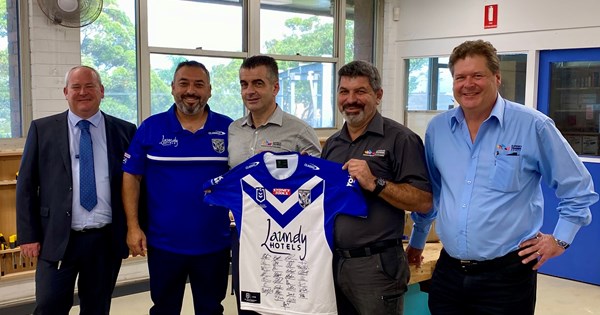
The Canterbury-Bankstown Bulldogs have taken a major step in assisting local students in attaining apprenticeships and traineeships, by developing a tailored program in partnership with Superior Training Centre (STC) for schools that will bridge the gap between skills and employment in South West Sydney.
In a partnership with local employers in the area, the program will create introductory programs for students, including School Based Apprenticeships and Traineeships.
These programs and opportunities will provide viable pathways to employment, particularly in those areas where skilled tradespersons are in short supply.
The program will provide a new approach in this area, with the Bulldogs, STC and local schools all working closely to understand the challenges and needs of students and parents.
Superior Training Centre Managing Director, Richard Bencic, was excited about working closely with the Bulldogs:
“We work very closely with industry and employers and can see first-hand the skills gaps and challenges business face trying to find skilled and qualified staff. We saw what the Bulldogs were doing in the community and believe our values and vision for local area aligned. It made sense to partner up with the Bulldogs so we can work hand in hand to address these issues”.
Bulldogs General Manager of Community, Fayssal Sari, could also see the benefits of an aligned approach:
“We’ve listened to schools in our local area about the challenges they face providing pathways to employment for many of their students. Employment opportunities are more than just earning money, they are about participating and contributing to the broader community. When we met with STC, they listened to the challenges schools are experiencing and helped us create a strategy to upskill students and create greater employment opportunities.”
Visit the Superior Training Centre website for more info here.

Today marks an annual spring conscription in Russia, which aims to round up more than 100,000 men for a one-year tour of military duty.
As Moscow's forces bog down in Ukraine, many young Russians of draft age are increasingly jittery about the prospect of being sent into combat, the Associated Press reports.
All Russian men aged 18-27 must serve one year in the military, but a large share avoid the draft for health reasons or deferments granted to university students.
Defence Minister Sergei Shoigu pledged this week that the new recruits won't be sent to front lines or “hot spots.”
“I don't trust them when they say they won't send conscripts into combat. They lie all the time,” said Vladislav, a 22-year-old. He asked that his last name not be used, fearing reprisals.
Even though President Vladimir Putin and his officials say that conscripts aren’t involved in what Russian authorities call “the special military operation in Ukraine,” many appeared to have been taken prisoner during its initial days. Videos emerged from Ukraine of captured Russians, some being shown calling their parents, and were put on social media.
The mother of one of the prisoners said she recognized her 20-year-old draftee son in a video even though he was shown blindfolded.
“I recognized him by his lips, by his chin. You know, I would have recognized him by his fingers,” said the woman, who asked to be identified only by her first name, Lyubov, for security reasons. "I breastfed him. I raised him.”
The Defence Ministry was forced to walk back its statements and acknowledge that some conscripts were sent to Ukraine “by mistake” and were taken prisoner while serving with a supply unit away from the front.

