After a long wait Sony has finally announced long awaited details on how users can expand the local storage on the Playstation 5, and it’s not exactly straightforward unless you have the right SSD, but thankfully Seagate has just released their FireCuda 530 SSD which drops straight in..
The update to the Playstation support page came through late last week. At this stage we here in Australia can’t test it out, as the PS5 Beta program which is running the update is only available to users in the United States, Canada, Japan, United Kingdom, France, Germany. So we’ll get the update just as part of an official one, once the Beta testers have finished.
But what do you actually need in terms of hardware? Well, those testing the storage expansion will need a PCIe Gen4 x4 M.2 NVMe SSD between 250GB – 4TB with read speeds starting at 5,500MB/s.
Sony is also getting specific on dimensions of drives, with 22mm M.2 drives supported, though they also require either a heatsink or heat transfer sheet. The total size of the drive and cooling structure has to be under 110mm x 25mm x 11.25mm.
So, that’s all well and good, but which drive do you need? Well, the best option at this stage is the recently announced Seagate FireCuda 530 with a built-in heatsink. The drive has sequential read speeds of up to 7300 MB/s, and is also currently the only qualified drop-in expansion solution for the Playstation 5.
If you want to check out the FireCuda 530, you can check them out from leading retailers, MWave, Scorptec and Shopping Express in Australia from this month. The drive is available with and without heatsink – but if you want it for the PS5 you’ll need the Heatsink model. Pricing for the Seagate FireCuda 540 looks like this:
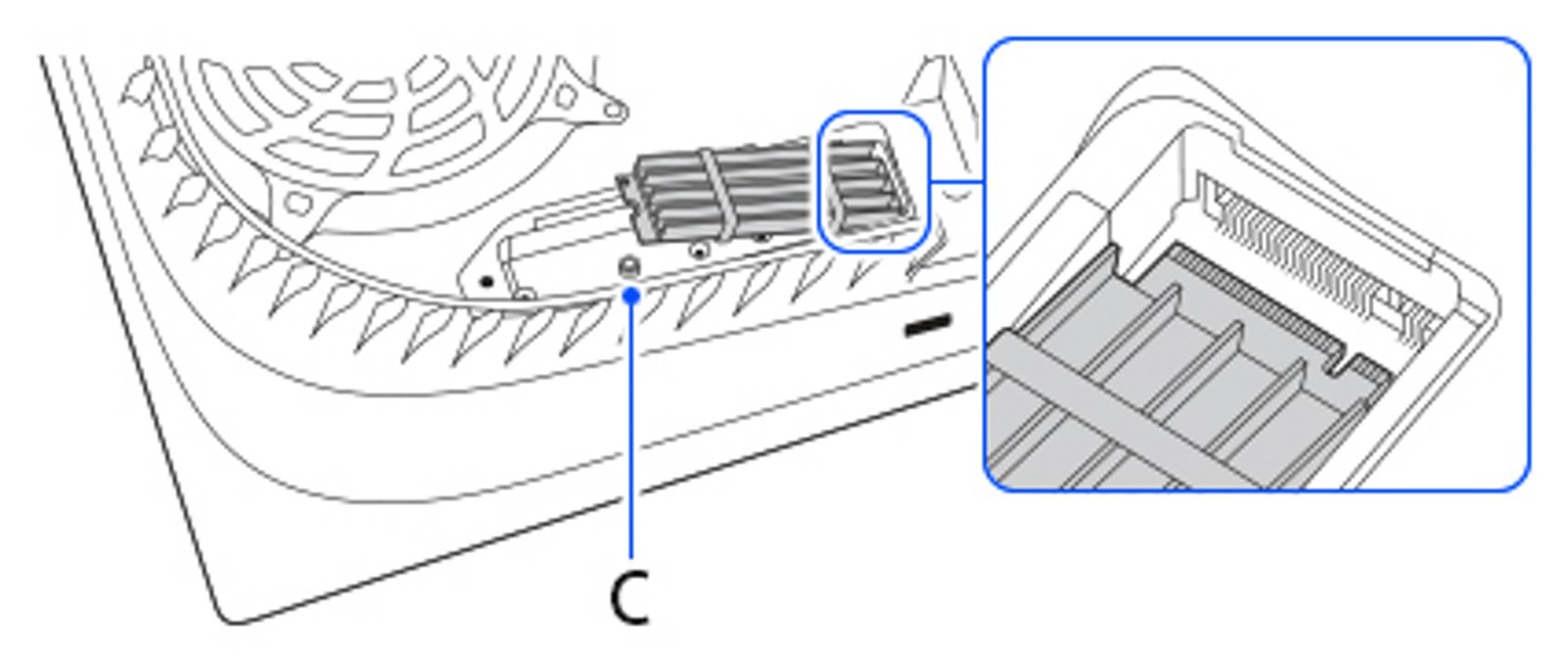
The instructions for installing the drive, once the Beta software is installed, includes a requirement for a well lit room, Phillips head screwdriver and optionally, a torch. Users will then need to remove the fins of the PS5 and slot the unit into the available slot before reassembling the console.
Despite the higher end requirements for the drive, Sony is already downplaying expectations for the update saying ‘Not all games are necessarily playable with the exact same performance provided by the PS5 console’s internal Ultra-High Speed SSD, even where the M.2 SSD device’s sequential read speed is faster than 5500MB/s’. Still, it’s going to be faster than running an external drive.
If you do decide to strike out on your own in choosing an SSD, it could get a little technical – but that Seagate FireCuda 530 looks to be pretty easy. Frankly it does make the storage expansion slot on the rear of the Xbox Series X look elegantly simple by comparison.
Of course with no access to the PS5 Beta program available we’ll have to wait for the option to expand storage here in Australia.
Residents in the Victorian-NSW border bubble will only be able to enter Victoria without a permit for six essential reasons from 11:59pm Tuesday, in an effort to prevent the NSW outbreak from spreading.
Key points:
Health Minister Martin Foley said people entering Victoria for essential reasons should limit their travel south as much as possible
The permitted reasons also apply to Victorian border bubble residents who plan to enter New South Wales
The changes take effect from 11:59pm Tuesday, with fines of up to $5,452 for breaches
The reasons are:
Necessary goods and services including medical care and COVID tests
Care and compassion reasons
Paid or voluntary work
Education including childcare
COVID-19 vaccination
Sport and exercise
Health Minister Martin Foley said the government was trying to strike a reasonable balance while limiting potential transmission.
Mr Foley said the rules would also apply to Victorian residents travelling into New South Wales, meaning their travel into NSW must be essential if they wish to re-enter Victoria without a permit.
The restrictions do not apply in emergencies or if someone is escaping family violence.
From 11:59pm Tuesday, movement into Victoria from neighbouring NSW communities will be highly restricted.(
ABC Mildura-Swan Hill: Jennifer Douglas
)
Mr Foley acknowledged the tightened restrictions would cause stress and difficulty for border communities, but said previous protocols were not drawn up with the Delta variant in mind.
“We know that will have an impact on many border residents but we also know that an outbreak of the Delta variant on our doorstep will have an even more negative impact on our border communities," he said.
Mr Foley said the decision was made based on advice from the Chief Health Officer "given the deteriorating situation in New South Wales".
"Things in NSW are expected to get worse before they get better, and we want to make sure that our border-bubble arrangements are based on that risk assessment," he said.
Melbourne enjoyed its first weekend of eased restrictions, with pubs and cafes able to welcome people back.(
ABC News: Scott Jewell
)
In a slight easing of restrictions from 11:59pm Tuesday, there will no longer be limits to group bookings at hospitality venues, tours and gyms.
Mr Foley said the broader density limit of one person per 4 square metres would continue to apply.
Three COVID-19 cases are in intensive care
Victoria recorded two new locally acquired COVID-19 cases on Sunday, both of which were linked to the current outbreak and were quarantined while infectious.
Department of Health official Kate Matson said one of the new cases was a household contact of a case from the AAMI Park cluster and the other was a household contact of the testing site worker who tested positive last week.
She said there were eight cases in hospital, including three in intensive care.
The cases were detected from among 21,417 test results.
There were more than 15,000 vaccine doses administered at state-run vaccination hubs on Sunday.
As of Sunday, 19.2 per cent of Victorians aged 16 and older were fully vaccinated.(
ABC News: Daniel Fermer
)
On Sunday, Chief Health Officer Brett Sutton said the state was "tracking really well" for the anticipated easing of restrictions next Wednesday.
Melbourne International Film Festival runs hybrid model
The Melbourne International Film Festival will open up to online audiences across Australia this year, as it again grapples with density limits in cinemas.
The festival's artistic director Al Cossar said in a statement the festival was using the Coburg Drive-In cinema to try to boost the number of people able to view the selection of films at a venue.
The festival's online streaming service will also be available from Friday to anyone across Australia, with about 90 films available over the course of the event.
"In the midst of COVID-era calamity, constraint and complication, MIFF keeps moving forward to meet audiences where they are, including those in lockdown currently," Mr Cossar said.
"Our whole festival team is working extremely hard to ensure that we can create and sustain as many opportunities for audiences to be a part of the festival this year as possible."
Meanwhile, Victoria's peak tourism body has estimated it will take between three and five years for Melbourne tourism operators to recover from the pandemic.
The Victorian Tourism Industry Council's Felicia Mariani said regional areas had enjoyed a rush of city residents holidaying in the country after each lockdown, but operators in the city were struggling.
"The defining moment in all of this has been the plight of our capital cities, Melbourne and Sydney in particular because of the reliance on international visitors, on major events, business travel," she said.
"All of those elements have been shut off at the moment."
She estimated visitor spending across Victoria had fallen by $22 billion in the 12-month period to March due to international and interstate border closures.
Space to play or pause, M to mute, left and right arrows to seek, up and down arrows for volume.
Calls for bipartisan approach to combat anti-lockdown, anti-vax protests.
From Wednesday, travellers in the bubble will only be able to cross the Murray River without a permit to access necessary goods and services, care reasons, work and education, vaccination, and exercise.
Health Minister Martin Foley said the changes apply for both NSW and Victorian residents.
“The outbreak in NSW continues to grow, and with projections and modelling suggesting that the position in New South Wales is likely to get worse before it gets better, it’s prudent that Victoria takes measures to make sure that the border bubble operates as safely as we possibly can,” he said.
“We really don’t make these changes lightly.”
Fines for those who cross the border into Victoria for unnecessary reasons are up to $5452.
Changes to group bookings flagged for Victoria
Mr Foley also announced another change to the state’s COVID-19 rules: there will no longer be limits to group bookings for hospitality venues, tours and gyms.
However, Mr Foley said that the broader density limits that were announced last week will continue to apply.
“Whilst the overall limit of 100 or 300 inside or outside will continue to apply, the group booking limit of 10 will be removed,” he said. “That was in response to some suggestions that came forward from industry, as to how to best address that issue.”
The group booking rule will change from 11.59pm on Tuesday, Mr Foley said.
“As the Chief Health Officer has shown by just that tweak for group bookings, the public health team are always open to sensible suggestions, but equally the team made it pretty clear that the two-week arrangement was in place for that careful, stepped process of managing the Delta variant of concern.”
Almost 7000 waiting to return to Victoria
Meanwhile, almost 7000 people are waiting on their application for travel into Victoria from “red” and “extreme” zones to be considered, with health authorities processing around 1000 exemption applications a day.
Victorian Health Department deputy secretary Kate Matson said due to the volume of applications from those in NSW and Queensland, they would be prioritising processing “emergency” applications.
Each application has to be independently considered by the department’s public health team, she said.
“I do want to note that approving those exemptions is rare,” she said at a coronavirus briefing on Monday.
“Most people who apply will not be successful in getting that exemption. For those who do, it tends to be some really compelling compassionate or emergency grounds, such as end-of-life reasons, attending funerals and so on.
“We really do understand for people in those difficult circumstances it can be really stressful, waiting for the exemption results, and I reassure you that we are working through those as quickly as we can.”
A return to ‘doughnut days’ soon: Sutton
Loading
There are now just 56 exposure sites listed in Victoria, down from the more than 300 exposure sites listed at the height of the Victoria outbreak.
Chief Health Officer Brett Sutton said Victoria will soon be able to enjoy “proper days of zero” cases, as the number of primary close contacts required to be in quarantine drops.
“We’ll get additional cases over the coming days, but they’ll get fewer and fewer,” he told reporters on Saturday.
“But at some point in time, in the next week or so, we will run out of individuals who are close contacts who could test positive, and we will have those proper days of zero again.”
Data released by the Department of Health on Sunday revealed that of 204 COVID-19 positives in Victoria since July 12, there were just 25 cases in people who had received at least one dose of the vaccine.
Only 10 were fully vaccinated, with none hospitalised due to the virus and all either asymptomatic or suffering only mild symptoms.
Millions of Queenslanders have been ordered into an extended lockdown as the state fights to contain the most serious COVID-19 threat it has faced in a year.
The state recorded 13 new locally acquired cases of the highly infectious Delta variant on Monday, all linked to a cluster involving high-risk exposure sites including six schools and public transport routes.
A total of 31 cases have been linked to the cluster so far, with Chief Health Officer Jeannette Young expecting many more in coming days.
A snap three-day lockdown due to end at 4pm on Tuesday has been extended until 4pm on Sunday, so contact tracers can find people who've come into contact with infected individuals and get them quarantined.
That's no small task given many cases are linked to two schools, with four others considered high-risk exposure sites.
More than 10,000 people are in isolation and that number is expected to climb.
Dr Young has warned the length of the lockdown will depend on how seriously residents of the south-east corner take her stay-at-home order.
"We need to lock down really, really hard - the hardest we have ever locked down," she told Queenslanders on Monday. "If you don't need to leave your house, don't."
The cluster began on Thursday with a single positive case involving a 17-year-old student from Indooroopilly State High School. By Saturday, there were six more cases. On Sunday, nine more were added.
Of the 13 new cases reported on Monday, seven are students from Ironside State School, five are household or family contacts of those students, and one is linked to a confirmed case associated with a karate school that trains at that school.
One of the new cases was active in the community for six days while infectious, demonstrating the level of risk.
Dr Young also revealed 10 of the 13 cases involve children aged nine and under, noting that younger people with the Delta variant are far more likely to transmit it to other people.
"So I am very worried about those schools," she said.
Acting Premier Steven Miles said Queensland had never before seen an outbreak involving significant spread amongst students, teachers, parents, extracurricular activities and public transport.
"It will likely see thousands of people subject to home quarantine directions," he warned.
Mr Miles also said he had no choice but to cancel this year's Ekka, Queensland's annual agricultural show, the second time it's been canned in two years due to the epidemic.
Workers in the locked-down south-east corner have been told they must do their jobs from home if at all possible, and employers have been warned not to misrepresent workers as "essential" staff when they are not.
"I cannot understand why anyone would be in an office today. If you are in an office today, why aren't you at home?" Dr Young said.
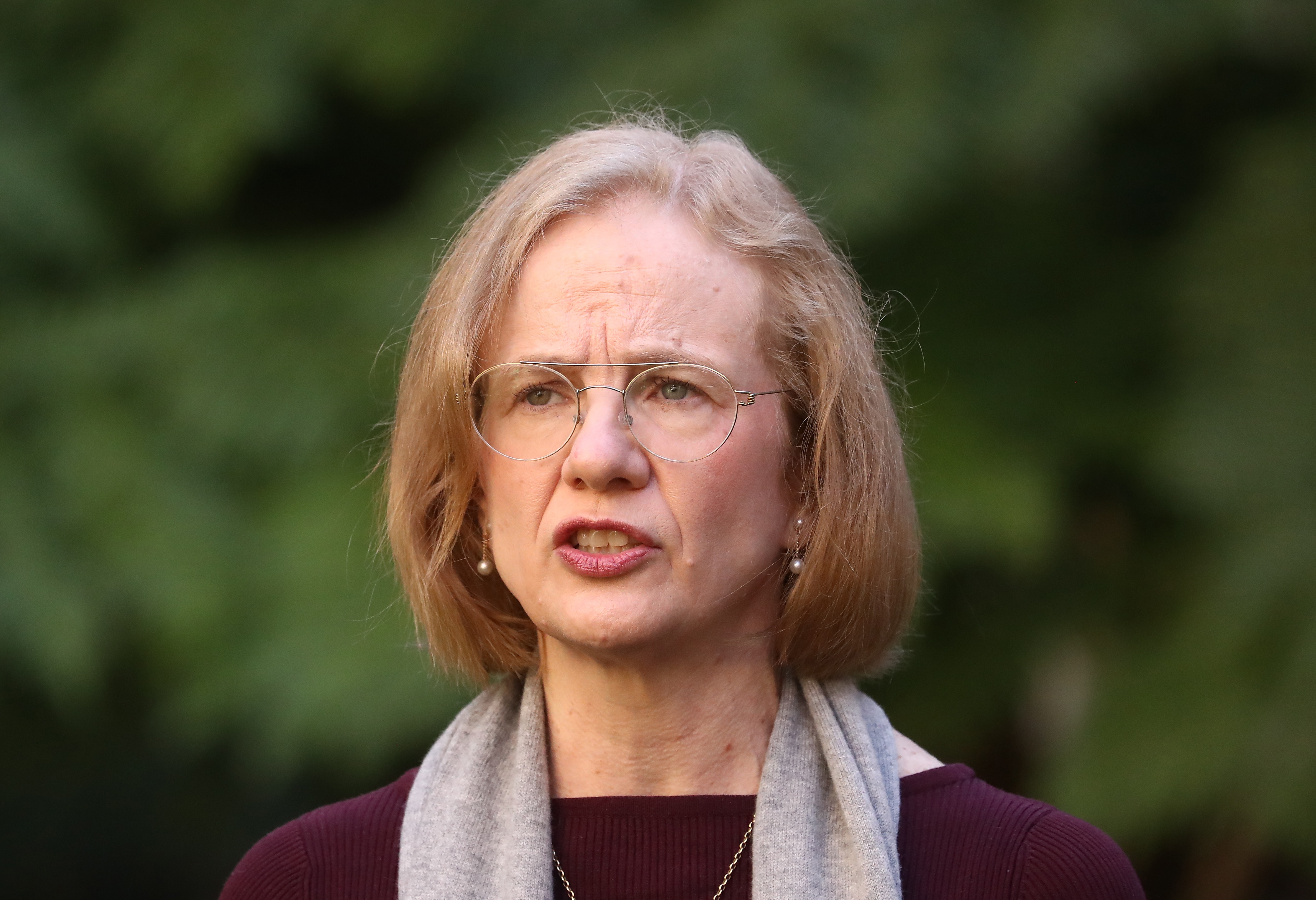
Queensland Chief Health Officer Dr Jeannette Young during a press conference in Brisbane, Sunday, August 1, 2021
AAP
Home learning will begin for state schools on Tuesday, and private schools are making similar arrangements. Schools will remain open for the children of essential workers.
Treasurer Cameron Dick also announced $260 million in financial support for small and medium businesses hit by the public health orders.
Payments of $5,000 will be available for businesses hit by the lockdown in south-east Queensland, lockdowns in other states and border closures.
But he warned online application processes were not yet in place, and it could be another fortnight before business owners can begin applying for the money.
Authorities in the regional community of Rockhampton are also on alert after an infected contractor travelled there from Brisbane, for work relating to the Rookwood weir.
Member for Keppel, Brittany Lauga, says students from Mt Morgan State School visited the weir and will be prioritised for testing, along with the contractor's colleagues.
Two other cases reported on Monday involve crew members of a bulk carrier off the Queensland coast.
Future Health Research and Innovation (FHRI) Fund supports 126 high-performing Western Australian researchers with grants worth $6.4 million
Additional $2.8 million in infrastructure support from the FHRI Fund for medical research institutes
The FHRI Fund was established by the McGowan Government to provide a secure source of funding for health and medical research and innovation
A Royal Perth Hospital anaesthetist is leading global research to determine whether a commonly used local anaesthetic can play a role in reducing the incidence of chronic pain following breast cancer surgery.
Professor Tomás Corcoran is among 126 high-performing Western Australian researchers sharing in $6.4 million of research infrastructure funding from the Medical and Health Research Infrastructure Fund (MHIRF).
His study will establish whether Lidocaine, an anaesthetic drug also known as Lignocaine, can reduce the likelihood of patients experiencing ongoing post-operative pain if it is administered intravenously during surgery and up to 24 hours afterwards.
Long-term pain following breast cancer surgery is believed to result from a biological mechanism that is triggered around the time of surgery and that once switched on, cannot be switched off.
While about a third of breast cancer patients have mild post-surgical pain at the site of their wound, around one in eight experience moderate to severe pain that persists beyond four months. For some, it becomes a lifelong burden.
Professor Corcoran was awarded a grant of $4.3 million from the national Medical Research Future Fund in 2020 to run the trial - known as the LOLIPOP trial - in 4,440 patients through the Australia and New Zealand College of Anaesthetists clinical trials network.
He expects to begin enrolling patients in Australia in the next few months.
On top of the $6.4 million in MHRIF, six WA eligible medical research institutes will share in $2.8 million under the Research Institute Support (RIS) program.
RIS funding is allocated based on each institute's researchers' success in obtaining competitive grant income. It enables them to buy resources essential for supporting quality research.
The six institutes are:
Harry Perkins Institute of Medical Research;
Institute for Respiratory Health;
Lions Eye Institute;
Perron Institute for Neurological and Translational Science;
Telethon Kids Institute; and
Women and Infants Research Foundation.
Both the MHRIF and RIS programs are supported by funding from the FHRI Fund.
The FHRI Fund was established by the McGowan Government in 2020 to provide a secure source of funding for health and medical research and innovation.
Comments attributable to Medical Research Minister Roger Cook:
"The MHRIF program enables outstanding WA researchers to remain competitive in their pursuit of national and international funding.
"Thanks to the support they receive through MHRIF, they are able to run important research projects such as this international multi-centre trial.
"This project will give WA breast cancer patients the chance to participate in world-class research - and potentially be spared from a lifetime of pain and related health issues."
Victoria recorded two new locally acquired cases on Monday after Chief Health Officer Brett Sutton flagged the state could start seeing doughnut days again soon.
Both new cases are linked to the current outbreak and were in quarantine for their entire infectious period, the Department of Health confirmed on Twitter.
More than 21,400 tests were returned on Sunday, while 15,030 vaccine doses were administered.
The figures come after Professor Brett Sutton said Victoria will soon be able to enjoy “proper days of zero” cases, as the number of primary close contacts required to be in quarantine drops.
“We’ll get additional cases over the coming days, but they’ll get fewer and fewer,” he told reporters on Saturday.
“But at some point in time, in the next week or so, we will run out of individuals who are close contacts who could test positive, and we will have those proper days of zero again.”
Data released by the Department of Health on Sunday revealed that of 204 COVID-19 positives in Victoria since July 12, there were just 25 cases in people who had received at least one dose of the vaccine.
Only 10 were fully vaccinated, with none hospitalised due to the virus and all either asymptomatic or suffering only mild symptoms.
After Victorian health authorities declared parts of south-east Queensland a “red zone” on Saturday night, Professor Sutton said more than 5000 people who returned before the change was made would be asked to get another COVID-19 test.
He said those who returned to Victoria when parts of Queensland were declared “orange zones” would receive a message from the health department to get tested seven days after their first swab.
Victorians returning from a “red zone” must get tested immediately and isolate for 14 days.
Ashleigh McMillan is a breaking news reporter at The Age. Got a story? Email me at a.mcmillan@theage.com.au
Facebook and other social media have been under scrutiny for vaccine misinformation, but local outlets have also sometimes been active.
The Freedom’s Phoenix, a local news site in Phoenix, and The Atlanta Business Journal, a news site in Atlanta, both published the same article about coronavirus vaccines in March.
The author was Joseph Mercola, who researchers and regulators have said is a top spreader of misleading Covid-19 information. In the article, Dr. Mercola inaccurately likened the vaccines to “gene therapy” and argued against their usefulness.
A month later, The Freedom’s Phoenix and The Atlanta Business Journal also published another article by Dr. Mercola. This time, he blamed the billionaire Bill Gates for the pandemic, claiming Mr. Gates had “shadow control” of the World Health Organization.
Facebook and other social platforms have in recent weeks attracted attention for vaccine misinformation, as Covid cases surge from the infectious Delta variant and vaccination rates slow. But The Freedom’s Phoenix and The Atlanta Business Journal are two small publications — along with dozens of radio and television stations, and podcasts aimed at local audiences — that have also become powerful conduits for anti-vaccine messaging, researchers said.
Dr. Mercola and other superspreaders of anti-vaccine content, who have been listed by the nonprofit Center for Countering Digital Hate as the “Disinformation Dozen,” have appeared in articles in local publications or as guests on local radio shows and podcasts, according to a review by The New York Times. Some of their articles are regularly published by small-town newspapers or they are quoted as experts, The Times found.
Sherri Tenpenny, an osteopathic physician and vaccine skeptic, was recently on Coach Dave Live, a podcast in Ohio aimed at local audiences, misleadingly claiming that coronavirus vaccines disrupt people’s fertility. Christiane Northrup, a physician and anti-vaccine activist, showed up on the Lillian McDermott radio show in Florida and inaccurately said the vaccines would “change human DNA.” Ty Bollinger, another vaccine skeptic, was featured on News4 WSMV Nashville, an NBC-affiliated station in Tennessee, where he discussed why people should not get vaccinated.
Their appearances on local media can have an impact since Americans are more likely to believe what they read and hear from local news outlets. A 2019 Knight-Gallup study found that 45 percent of Americans trust reporting by local news organizations “a great deal” or “quite a lot,” compared with 31 percent for national news organizations.
“People think they are trusting their local news, something reliable and familiar, when in fact they are trusting misinformation,” said Rachel Moran, a fellow at the Center for an Informed Public at the University of Washington. “It is a huge problem and growing.”
The Freedom’s Phoenix, The Atlanta Business Journal, Coach Dave Live, Lillian McDermott show and News4 WSMV did not return requests for comment.
In an email, Dr. Mercola wrote, “Local communities must come together when the federal health agencies and mainstream media are under the influence of the pharmaceutical industry.”
Dr. Tenpenny, Dr. Northrup and Mr. Bollinger didn’t respond to requests for comment.
Many local media publications and stations have reported responsibly and factually on the pandemic. Gannett, the publisher with 100 daily newspapers and nearly 1,000 weekly publications across 43 states, has dedicated resources to fact-checking and teaching journalists that accuracy matters more than speed, said Amalie Nash, senior vice president for local news and audience development at USA Today, which is owned by Gannett.
The investment was crucial because in the pandemic, “people turned to us in record numbers to get information about lockdowns, mask policies and vaccines,” Ms. Nash said.
But as the local news industry has been hit by declining advertising revenues and cuts, some outlets have sometimes unknowingly run vaccine misinformation because they have fewer employees or less oversight than in the past, said Ken Doctor, a news industry analyst. Without the resources to publish original, independent journalism, they may also rely on whatever can be freely repurposed from online material, he said.
In total, local media remains a significant force. There were 1,762 local television stations and 3,379 radio stations operating in the United States last year, according to the Radio Television Digital News Association and Syracuse University. While print publications have been decimated, there are still about 1,300 daily papers and 5,800 weekly publications, with roughly half located in small rural communities, according to research from the University of North Carolina.
Jo Lukito, an assistant journalism professor who studies disinformation at the University of Texas at Austin, said local media is often a starting point that creates a “trading up the chain” effect.
It starts when a rumor is covered or published in local media, she said, where it can gain a sheen of credibility. Then “when you pitch it to a Fox News or a larger news platform, you can say that this other outlet covered it, so it must be real,” she said.
George Noory, host of the radio talk show Coast to Coast AM, in his studio in 2017.Ivan Kashinsky for The New York Times
One radio show that appears to have been part of that effect is Coast to Coast AM, which is syndicated on 640 local stations and reaches nearly three million weekly listeners. Its host, George Noory, has in recent years interviewed Dr. Tenpenny, Robert Kennedy Jr., a lawyer and anti-vaccine activist, and Erin Elizabeth, the founder of the website Health Nut News and a vaccine skeptic.
The activists have used their segments on the show to reinforce their messages. In a promotion for Dr. Tenpenny’s appearance to discuss the coronavirus in April 2020, for example, Coast to Coast AM’s website said, “She contends that there are so many unknowns in regards to testing, tracking, symptoms, and other factors, that the information we’re being told about the disease is meaningless.”
That line was shared on Dr. Tenpenny’s social media accounts and tweeted by some of her followers.
In a statement, Mr. Noory said, “We give all views on my program and that includes people who are opposed to vaccines.”
Vaccine misinformation has also been published on sites that purport to be local news, but which are pay-for-play content websites. These sites, where articles are ordered up and paid for by conservative think tanks, political operatives, corporate executives and public-relations professionals, have sprung up to fill the vacuum left by the loss of local publications.
Recent articles on some of those sites, such as Last Frontier News in Alaska and Bowling Green Today in Kentucky, highlighted people who died after receiving the Covid vaccines without saying that it was unclear if the vaccines were responsible, according to a review by The Times. The stories followed a pattern established on anti-vaccine blogs of pulling data from a national database of post-vaccine deaths without explaining the limitations of the data.
Last Frontier News and Bowling Green Today did not respond to requests for comment.
At least one local radio host has recently recanted his anti-vaccine stance. Phil Valentine, a conservative radio host in Tennessee, had declared in a blog post in December that he would not get the vaccine because his chances of dying from the virus were “way less than one percent.”
But Mr. Valentine was diagnosed with Covid-19 in July and has been hospitalized in critical condition. He has since issued a statement advising others to get vaccinated.
“Phil would like for his listeners to know that while he has never been an ‘anti-vaxxer’ he regrets not being more vehemently ‘pro-vaccine’, and looks forward to being able to more vigorously advocate that position as soon as he is back on the air, which we all hope will be soon,” his station, 99.7 WTN, said on July 23.
Last Wednesday, Mr. Valentine was put on a ventilator, 99.7 WTN said. The station has added a hashtag to its posts about the host: #prayforphil.